
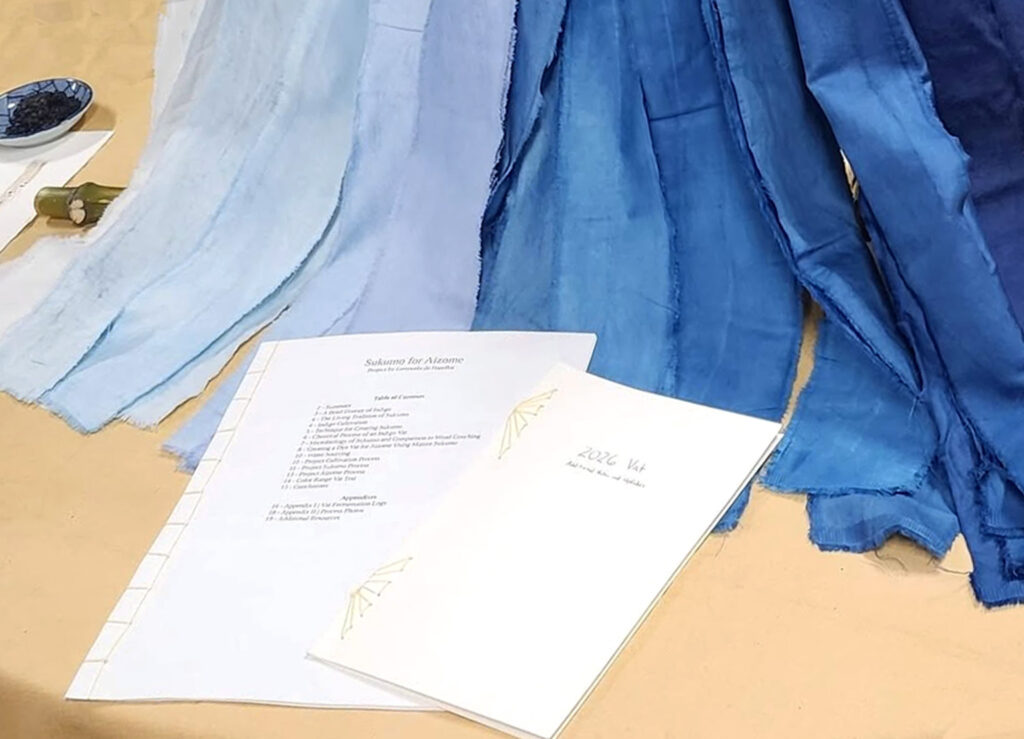
For a number of reasons, the sukumo based vat that I built in 2025 had to be neutralized and disposed of. I also found myself needing to start a new vat in less than ideal conditions at a new location. As the ability to function in cooler weather than most indigo vats is the primary technological advance seen in sukumo vats as compared to other types of indigo vats, establishing a vat in the winter without a greenhouse or other warming system in a climate with colder winter low temperatures created an interesting opportunity to test the bounds of what could be possible.
The 2025 vat was maintained into early December 2025, well past the first frost of the year, and remained viable until the day I neutralized the pH so it could be safely emptied. That vat was started under much more desirable circumstances, but held up well once established. My 2026 vat was built in a plastic 5 gallon bucket stored in a well house that offered some protection from the elements, but was only heated when freezing temperatures were anticipated. While the 2025 vat was built in a space with fairly consistent temperatures that ranged from 80f to the high 90s, the 2026 vat was cultivated with air temperatures that ranged from just above freezing to over 70f.
The same recipe and formula was followed for the 2026 vat as was outlined for the original project vat from 2025. The same guidelines were also followed regarding the addition of lime and wood ash, however the timeline and frequency with which additions were indicated was dramatically different. In the 2026 vat, color was very slow to develop and pH changed more gradually. Visual, textural, and scent related signs of vat activity were very difficult to perceive. In the 2025 vat, the vat changed rapidly at points making it very easy to notice that there was a difference, though it was often difficult to pinpoint what that difference was beyond the changes in pH and color visibility. The 2026 vat was a practice of hope and patience that showed little sign of progress until suddenly there was blue.
Once the vat was active, it remained slower to change and slower to recover when used. Where the pH of the 2025 vat needed regular additions of wood ash solution to maintain it at or above 10.5, the 2026 vat pH remained slow to change even after color developed. I suspect the lower air temperature resulted in slower fermentation, but I do not feel that the current amount of data is enough to disprove the possibility of other factors leading to this result.
Using the 2026 vat was complicated by the slower development and recovery time. With the 2025 vat I was able to dye multiple samples each day, and dye two days in a row followed by a day of letting the vat rest. With the 2026 vat, I was still able to dye multiple samples on some days, but the vat needed at least one day of rest after each use before it recovered enough to become viable again. The first samples dyed in each session got excellent coverage and depth of color, but the color transfer slowed rapidly. This made it possible to get very light shades in addition to the darks and midtones, something I struggled with in the 2025 vat, but it also resulted in an increased frequency of crocking and uneven color in the lighter value range samples.
Overall, I found the dramatically reduced speed at which the sukumo vat developed in cold weather to be difficult to manage compared to the warmer weather vat building experience where progress and potential issues are both more obvious, but I was also deeply impressed at the ability of sukumo to develop into a functional vat in such a wide range of conditions. When compared to modern chemical vats that often function best at temperatures of 120-130f, or other traditional techniques such as sig vats that also require more carefully maintained warmth, it is not difficult to see the utility of a vat that can be built and maintained under such a wide range of conditions.
2026 Vat Notes
| Date | Air Temp | pH | Stir | Notes |
| 2/10/2026 | 66f | 11.6 | X | Vat started |
| 2/11/2026 | 53f | 11.5 | X | |
| 2/11/2026 | 60f | X | ||
| 2/12/2026 | 45f | 11.5 | X | |
| 2/12/2026 | 59f | X | ||
| 2/13/2026 | 40f | 11.2 | X | |
| 2/13/2026 | 51f | X | ||
| 2/14/2026 | 35f | 11.3 | X | |
| 2/14/2026 | 52f | X | ||
| 2/15/2026 | 48f | 11.2 | X | |
| 2/15/2026 | 49f | X | ||
| 2/16/2026 | 45f | 11.2 | X | |
| 2/16/2026 | 60f | X | ||
| 2/17/2026 | 45f | 11.3 | X | |
| 2/17/2026 | 61f | X | ||
| 2/18/2026 | 57f | 11.2 | X | |
| 2/18/2026 | 69f | X | ||
| 2/19/2026 | 65f | 11.0 | X | |
| 2/19/2026 | 72f | X | ||
| 2/20/2026 | 63f | 11.0 | X |
| 2/20/2026 | 74f | X | ||
| 2/21/2026 | 58f | 11.1 | X | |
| 2/21/2026 | 60f | X | ||
| 2/22/2026 | 37f | 11.1 | X | |
| 2/22/2026 | 45f | X | ||
| 2/23/2026 | 39f | 11.3 | X | |
| 2/23/2026 | 40f | X | ||
| 2/24/2026 | 46f | 11.2 | X | |
| 2/24/2026 | 51f | X | ||
| 2/25/2026 | 48f | 11.2 | X | |
| 2/25/2026 | 59f | X | ||
| 2/26/2026 | 57f | 11.1 | X | |
| 2/26/2026 | 59f | X | ||
| 2/27/2026 | 55f | 11.2 | X | |
| 2/27/2026 | 58f | X | ||
| 2/28/2026 | 61f | 11.1 | X | |
| 2/28/2026 | 67f | X | ||
| 3/1/2026 | 52f | 10.4 | X | Color appeared, sprinkle of shell lime added before stirring |
| 3/1/2026 | 77f | X | ||
| 3/2/2026 | 54f | 10.7 | X | |
| 3/2/2026 | 57f | X | ||
| 3/3/2026 | 51f | 10.7 | X | |
| 3/3/2026 | 58f | X | ||
| 3/4/2026 | 54f | 10.5 | X | |
| 3/4/2026 | 73f | X | ||
| 3/5/2026 | 60f | 10.5 | X | |
| 3/5/2026 | 77f | X | ||
| 3/6/2026 | 67f | 10.4 | X | Wood ash solution added and stirred in |
| 3/6/2026 | 78f | X | ||
| 3/7/2026 | 67f | 10.8 | X |