Measuring and Securing Skeins
The first step in recreating or approximating the dyes that can be positively identified in extant textiles from 10th century Norse settlements was to prepare the fiber. I chose a lace weight yarns in both silk and sheep wool in order to have any excess dyed fiber usable for weaving and embroidery projects to minimize waste. My first choice for sheep wool was something spun from the fleeces of a sheep breed that is part of the Northern European short-tailed group, such as Shetland or Norwegian Spaelsau to better approximate the wool that would have been used in this time and region, but locating a bulk sized cone of yarn that fit these criteria proved to be both difficult to find in stock and cost prohibitive. As such, I opted for Merino, which creates a greasier fleece and may have limited dye saturation even after scouring.
Even saturation of the dye was a priority. After each skein was measured and weighed (4 grams each), they were tied with a single long thread in a figure eight pattern to both minimally contain the strands of yarn and also attempt to prevent tangling. Tying this as loosely as possible is intended to prevent the figure eight thread from blocking the dye and creating a tie dye effect.
Scouring
All fiber skeins were scoured before being dyed. In modern practice, there are numerous washes made for scouring fiber, especially wool. In period, lye soap may have been used. There is evidence of lye soap being made as far back in history as ancient Mesopotamia.1 I was unable to find any evidence of lye soap existing in 10th century Norse settlements that wasn’t speculative. There is, however, evidence of the cultivation of soapwort and use as a saponin in medieval Scandinavia.2
Soapwort (Saponaria officinalis) is has a native range that includes most of Europe and expands as far east as the western end of Siberia. It likes cool environments at moderate to low altitudes, making it an accessible option for 10th century Norse dyers. It is rich enough in saponins to form a lather when any part of the plant is in contact with water, but when the plant is flowering the roots in particular become extremely rich in saponin. This makes soapwort a desirable option for washing delicate fibers, including wool and silk, even compared to modern synthetic solutions.
I prepared a wash made of soapwort by pouring 1 cup of boiling water over 1 tablespoon of dried soapwort and letting it steep for 30 minutes. After steeping, I strained out the plant matter and left the soapwort solution to cool completely. I placed the fiber to be scoured in a small bowl of tepid water and added the solution, then gently swished it around to avoid damaging the texture of the yarn. When the wash water became murky, I rinsed the skeins under running water until it ran clear.
Saturating
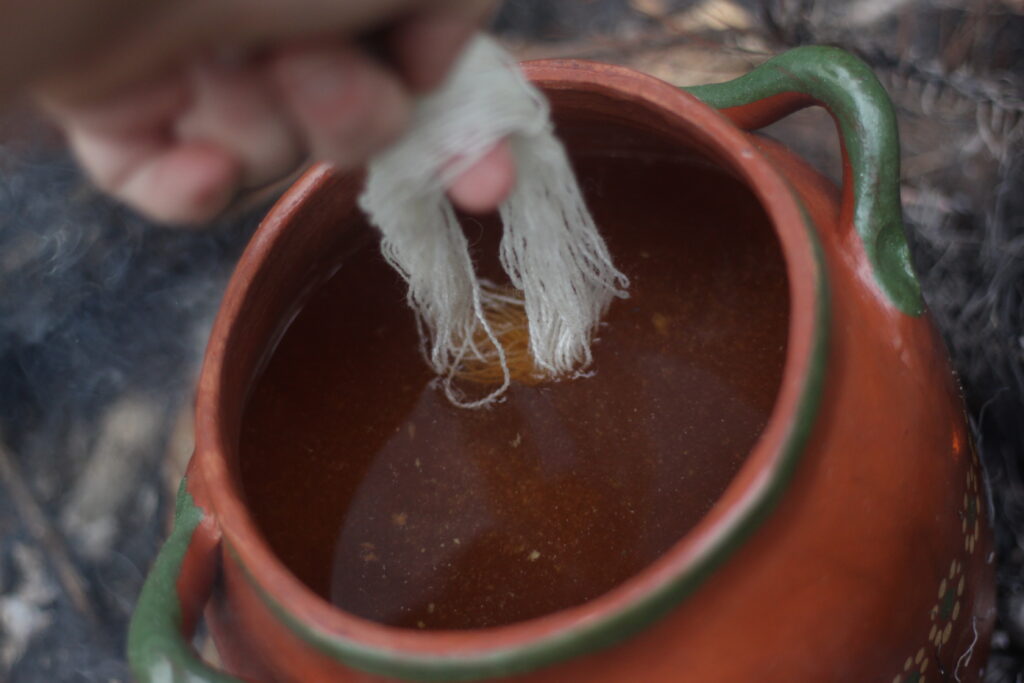
Once the skeins of yarn were washed, each one was placed in a dish of water to soak overnight with the intent of fully saturating the fiber. The silk was reluctant to absorb the water initially, and I found I got better results faster by placing a weight on top of the silk skeins to hold them below the water level. I aimed to keep each skein submerged until they were hydrated to such a degree that they no longer floated. 8 hours was a minimum, though some skeins were left to soak for as much as 48 hours as needed.
Temperature
The skeins that were prepared for dying were room temperature after being soaked in water. To avoid felting the wool or otherwise damaging the silk, these room temperature yarns were never added directly to an already hot dye pot. All yarns were either added to a room temperature dye bath and then slowly heated together up to temperatures never to exceed 160f, or they were gradually heated in water to within 10f of the temperature of the dye bath they are being added to.
Mordanting
Mordants Identified in Extant Textiles
A mordant is defined as a substance that combines with a dye and fixes it into the fiber. This is most often a metal oxide, but can include tannins, particularly when used with plant fibers. Tannins and ellagitannins were identified in some extant textiles, sometimes alongside madder, sometimes alongside unidentified compounds, and sometimes without any dye compound detectable. Evidence of alum was also found repeatedly, most frequently alongside luteolin. Alum was also detected alongside madder in a few samples, as well as with kermes.3
Tannins
Tannins and ellagitannins are present in a wide selection of foods and plants. Oak and walnut trees both produce these compounds, as well as fruits such as persimmons, grapes, and pomegranate. As there are native species of oaks present in both Scandinavia and the British Isles, as is Walnut, these are both likely sources for these tannin compounds. Walnut is also a known dye stuff that was positively identified in a textile sample from Hedeby. These tannins are commonly recommended in modern plant dying practices for preparing cellulose (plant) fibers to take dye. The fiber samples these tannin compounds were detected on in extant textiles were all silk or wool, which are protein not cellulose. This raises the possibility that these tannins may not have been used as a mordant, but as a dye themselves or a means of altering the final color of the other dye stuff. This could have been as a dye bath addition or a modifier.
Alum From Clubmoss
Multiple textiles from both the Mammen grave and the Hvilehøj burial mound showed evidence of alum being used as a mordant. This alum is most likely derived from a species of clubmoss (Lycopodiopsida), which is a family of ferns that serve as bioaccumulators of alum. There are over 400 species of clubmoss around the world.
Two species of clubmoss in particular were likely easily accessible in northwestern Europe during the 10th century, Diphasiastrum alpinum, which is also known as Alpine Clubmoss, and Lycopodiella inundata, which is also known as Bog Clubmoss. Both of these clubmoss species have ranges that extend throughout northwestern Europe, including Scandinavia and the British Isles. At this time, some of these species have dramatically reduced natural habitat, have been over harvested, or impacted by other changes in their environments, resulting in legal protections in some countries and generally being a target for conservation efforts.
Due to the protected status of many of the clubmosses native to northwestern Europe, I have opted to use an alternative. All Lycopodiopsida species bioaccumulate alum, so in theory they should all work as a source of alum for mordanting. Lycopodium digitatum, also known as Ground Cedar, is prolific where I live, so I decided to experiment with using that specific species of clubmoss for this purpose. This species of clubmoss does not grow in Europe and is native to North America. It is not, however, a protected species like many of its cousins.
Alum Process
To mordant fibers with clubmoss derived alum, I weighed out the desired amount of dried clubmoss, added it to approximately 100f water, held the mixture at this temperature for around 2 hours, then strained out the plant material. This like a very slightly green tinged liquid. Fiber to be mordanted was submerged in this solution for 48 hours before dying. The fiber mordanted is this solution did not pick up a visible tint from being submerged in it.
1Sakkaravarthi, Vinupriya. (2022). History of soap. Cosmoderma. 2. 133. 10.25259/CSDM_152_2022.
2Åsen PA. Medieval Monastery Gardens in Iceland and Norway. Religions. 2021; 12(5):317.
3Ina Vanden Berghe, Ulla Mannering, Charlotte Rimstad,
“New dye analyses of Danish Viking Age textiles from Bjerringhøj, Hvilehøj and Hedeby”,
Journal of Archaeological Science: Reports, Volume 49, 2023.