Tools Used in the Dye Process
Historical Tools and Practices
During the 10th century, very little of the equipment commonly used by modern dyers was available. Thermometers, non-reactive metal pots, bottled ammonia, modern cook tops, electric grinders, and more were not options. When viable, I have attempted to utilize solutions that, while often speculative, are possible options that could have been used in period. These include heating dyes over a fire or using a pot surrounded by hot coals for most dye baths. Due to time, space, and burn ban based constraints, some dye baths were done on a gas stove instead.
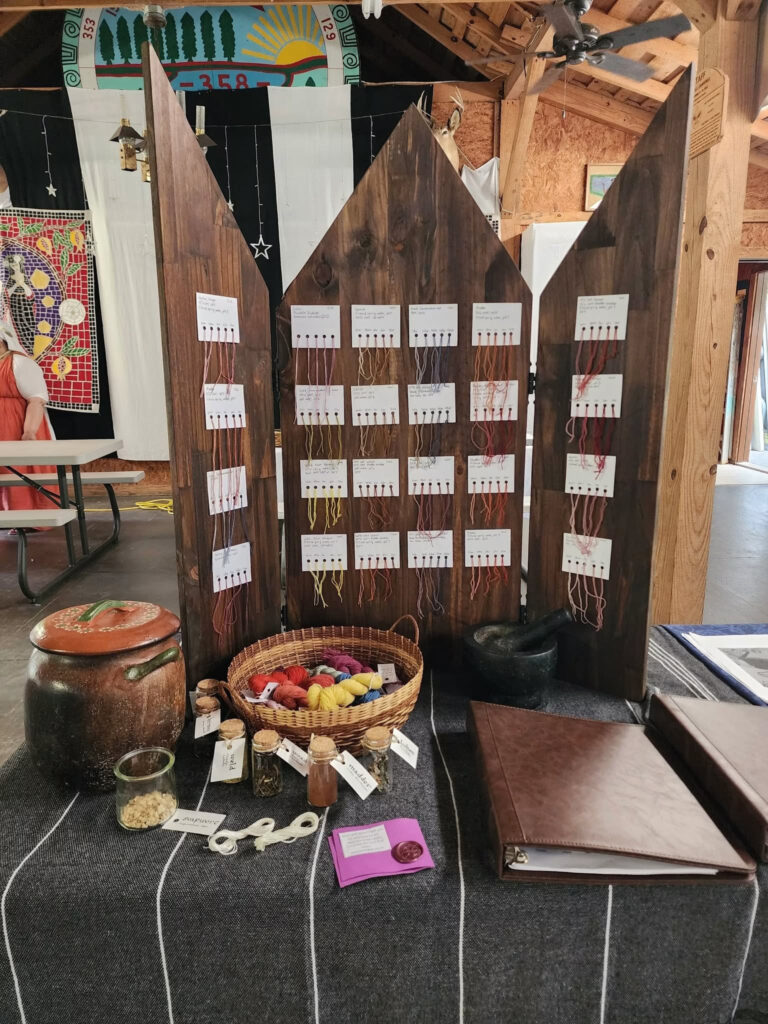
I utilized a clay pot for several dye baths, as pottery vessels are a known tool used for containing dye. Archaeological evidence of pottery with dye residue caked inside has been found around the world as far back as the Neolithic period.1 I only have one clay pot designated for dye work, however, and do not use food containers for dyes for safety reasons. As such, I ran some dye baths in stainless steel pots in order to better utilize time and firewood.
I also opted to regulate temperature primarily through observation without other tools. As dyers in early medieval period were creating vivid, saturated colors with dye stuffs that can be very temperamental when it comes to temperature fluctuations, I have to assume that the best of them must have been very well practiced and familiar with things like what the appearance of bubbling versus steaming meant for their dye.
Most of the dye baths I used needed to be maintained between around 100-120f. I assessed this without a thermometer by aiming to keep very minimal steam, warm to very warm to the touch, but never so hot that it was painful or injury inducing to reach into the dye bath bare handed. After each temperature assessment using sensory clues, I followed up with a thermometer reading for record keeping, which did inform my understanding of what sensations and visual cues equated to which temperatures.
Modern Tools Used
While I tried to limit myself to period practices and tools where at all viable, I freely used modern tools to periodically test the dye baths for record keep purposes. I noted the pH of each dye bath, as this can impact some dyes. I initially tried to use nitrazine paper for this purpose, but found that the dye interfered too much with my ability to read the reaction on the paper. A digital pH meter worked better.
I also utilized a thermometer for record keeping, as discussed above.
For safety reasons, I also used nitrile gloves when handling some of the dye baths and their residues. A concentrated solution of walnut dye can become caustic, as can the sediment in a woad vat, so I opted to wear gloves when handling both of these. A period solution might have been the use of a tool, such a stick, to keep distance between these substance and the skin.
For dyes that required ammonia, I also opted to use a modern solution. Ammonia throughout the middle ages and before was found by using an abundant and accessible natural source, human urine. Collected urine was held in vessels until going stale and then used for an assortment of tasks that household ammonia might be used for today, including woad vats and orchil lichen dye development. As both my woad vat and lichen jar were stored in my kitchen during the winter, I opted to use bottled ammonia for both sanitary reasons and to keep the peace with the people I share my home with.
Dye Baths and Vats
Madder
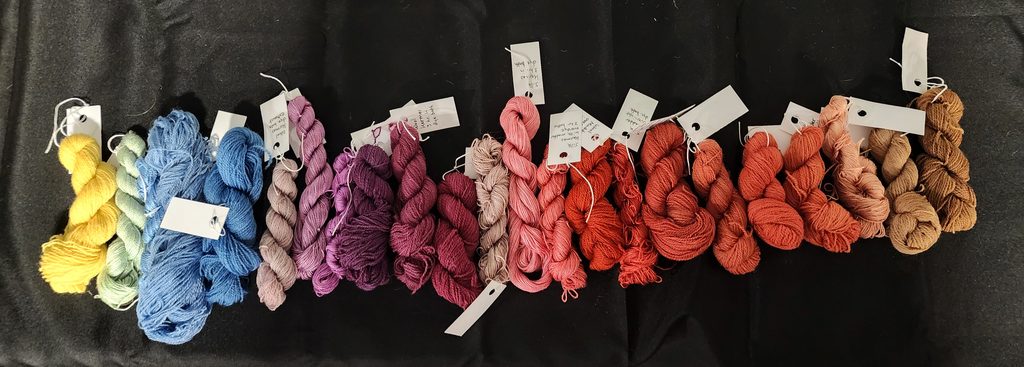
Madder was identified as a dye stuff at all sites where textile samples reviewed for this project originated. Madder was primarily identified through the presence of alizarin, purpurin, pseudopurpurin, and anthragallol. Between the dye analysis results and the geographic proximity to its growing range, the madder used was most likely Rubia tinctorum.
Madder is native to more southern areas of Europe, mostly surrounding the Mediterranean, but can be cultivated much further north. It is now naturalized through most of Europe, likely having been spread by intentional cultivation for use as a textile dye.2 We know madder was being grown in northwestern Europe by the 10th century, not just imported, because as early as 800 CE the madder plant is specifically named in the Capitularies of Charlemagne as a plant that should be grown in every village in the Frankish empire.
In the extant textile samples that showed evidence of madder, it was found alone, with indigotin, and with evidence of being overdyed with scale insects, with and without an alum mordant. It was also present in some samples alongside tannins that may have been a mordant, a dye bath addition, or an overdye.
For my madder dye bath, I dug 2nd and 3rd year roots of Rubia tinctorum after the first frost, when the foliage had begun to die back for the year. I separated established roots and younger rootlets. The more mature roots are dye rich and were set aside for that purpose. The smaller, younger rootlets are not a notable dye source, but are useful for propagating to begin the next crop of madder plants. As madder does not reliably flower or set seed outside of its native range, this is a probable period cultivation practice in northwestern Europe as well.
I made multiple batches of this dye bath, but all used the same general method. The madder baths were made by grinding the madder roots into a fine powder, weighing out the powder in the desired ratio to the weight of the fiber it was being used on, then pouring boiling well water over it, and leaving the mixture to steep overnight. After steeping overnight, the madder solids were strained from the dye bath.
For each batch, I added the yarns to the bath and warmed it to a temperature where it was warmer than skin temperature, but not hot enough to burn. Thermometer readings on these baths stayed between 110-120f as long as the dye was maintained at a point where it felt very warm, but not not painful to touch. Temperature was check and heat adjust accordingly at least once per hour during the dying process. Samples were removed at specific times and hung to dry.
Woad
The chemical indigotin was found to be present in many samples, but indigotin is present in numerous plants around the world, most notably indigo (Indigofera tinctoria) and woad (Isatis tinctoria). An assortment of other plants around the world are also indigotin bearing in to various degrees. While not well documented outside of the Minoan and Mycenean periods, murex seas snails can also be processed in a way that creates an indigotin dye. While it is not impossible for indigo or indigo dyed textiles to have traveled to this region during this time period, the geographic proximity to woad’s native range makes woad the far more likely source of this indigotin.
Woad is native to a range that extends from the Mediterranean east to parts of western Asia. The plant is far more tolerant of cold that other indigotin bearing species, however, and evidence of woad is found in the archaeological record in northwestern Europe and the British Isles dating to as early as the 1st century BCE. 3 It is currently naturalized as far north as Norway, suggesting it could certainly have been cultivated in the region during the 10th century. Woad can also be processed into fermented balls through a process called couching.4 These balls can be dried for easy transportation as a trade good to areas where it cannot be cultivated.
Woad is a biennial plant that is most indigotin laden in the leaves during the hottest parts of the year in its first year of growth. When the plant begins to grow a flower stalk in its second year, the plant ceases to produce notable quantities of indigotin and ceases to be of value as a dye plant. When fresh woad leaves are accessible during peak conditions for harvest, they can be used to create a blue dye with minimal effort. In any other situation, or for longer term use of the indigotin contained in the fresh leaves, woad has to be processed as part of a dye vat.
Dye vats differ from dye baths in that they are not simple extractions of the compounds within the dye material. Modern vats can be done using isolated chemical compounds, creating what is commonly referred to as a chemical vat. In the 10th century, a vat would have been created using a fermentation process with plant matter, or using woad and stale urine in what is known as a sig vat. All indigotin vats, whether they are based on woad, indigo, or another plant species that indigotin can be extracted from, have to contain three basic things: pigment, an alkaline compound, and a reducing agent. A reducing agent is anything that removes the oxygen from the vat. Indigotin is not water soluable and will not bond with fiber until these conditions are met.
While there are many different recipes for building a woad vat, the one best supported by the textile analyses I reviewed was a fermentation vat dye, most likely one using madder as a basis for fermentation. I used a combination of 1 part dried madder, 1 part wheat bran, and 4 parts soda ash, to 2 parts powdered woad. While I am currently cultivating woad plants, at the time that I initially established this vat, I did not have access to fresh woad leaves. I opted to use soda ash in place of wood ash lye, which was the most likely alkaline substance used in period to adjust the pH, as it was a safer option to in a house with small children. A urine based vat is the other likely candidate for the technique used in period, but for both hygiene and the comfort of everyone living in my home, I opted not to attempt that approach at this time.
To prepare the vat, I kept the fermentation jar near the stove in my kitchen to imitate a vat being kept warm by being kept near a hearth. While it was my hope to avoid using more modern equipment to establish this vat, after 10 days of fermentation not showing signs of progressing I decided to supplement the warmth and placed the vat on top of a warming mat intended for pet reptiles. In period, vats were likely started during the warmer months. Once a sig or fermentation vat is established, it can be maintained for many years, including by letting it rest in cold weather and reviving it when warmer days return. The timing of the start of this project necessitated starting this vat in November, however, and had to have supplemental heat under those conditions.
After adding additional warmth, the vat began bubbling overnight. I tested the pH and added additional soda ash until the pH reached 9. After another 48 hours, the vat began producing gold toned bubbles that began to turn blue after the vat lid was removed. I placed my yarn in water to warm up the approximately the same temperature as the vat (97f at that time), then squeezed as much water out as possible and lowered it into the vat still squeezed to minimize oxygen being introduced into the vat. Each skein was left in the vat for approximately three hours. These initial dye batches were then hung to dry and get oxygen contact with the fiber.
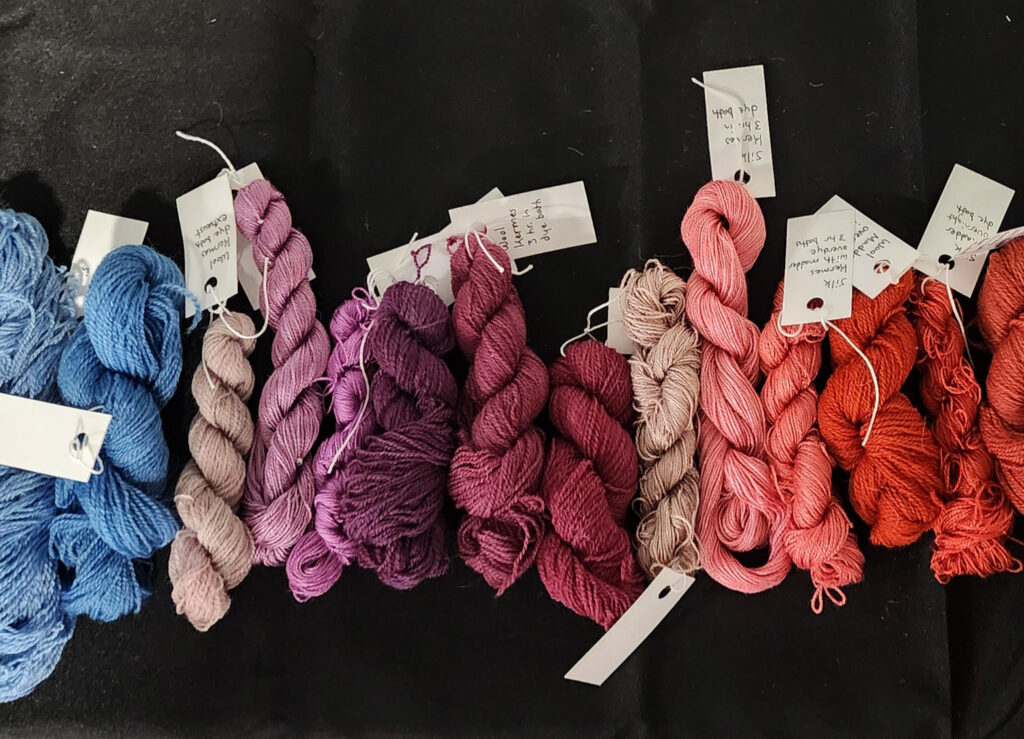
After giving the vat 24 hours to rest, the first batch of woad dyed yarns were all given a second three hour dip, followed by a repeat of the process for a third dip. After the third dip, the vat was allowed to rest again, and skeins of madder dyed and kermes dyes yarn were given a single three hour dip in the woad vat. I also gave one skein of wool yarn a fourth dip in the vat, then I finished off that round of using the vat by removing it from its warming pad and giving one skein of silk a single dip as the vat cooled in attempt to achieve a more turquoise color.
Once the vat was established, I was able to keep it maintained. I moved it outdoors into a warm space in the spring where I refreshed it with more woad extract, and feed it occasionally with wheat bran. While some samples included in the display of this project are from the initial dye batches done in this vat, I have also used the revived vat to dye new samples under current conditions.
Weld
Weld, also known as dyer’s rocket, was noted as the most likely dye stuff for a number of textile samples where luteolin was found present. Luteolin is a yellow dye compound found in greatest quantity in the flowers of weld. It has the distinction of being very lightfast for a plant based yellow dye.
For this dye bath I used dried weld flowers that I had saved from the previous year’s growing season. I weighed out enough weld flowers to meet the desired ratio to weight of fiber for each planned dye bath. The flowers were added to water and brought up to a boil for 1 hour, then removed from heat. The yarn I intended to use was pre-mordanted with clubmoss derived alum. I added the fiber to warm water and heated it while I strained the plant matter from the dye bath. Once the fiber was heated and the dye bath was clear of plant material, I added the fiber to the bath and maintained to heat to the desired level. These baths were kept as low as 110 and as high as 140.
Walnut
Juglone, which is primarily found in walnut, was found less often than evidence of woad, weld, and madder, but it was identified as a dye that was in use. Compounds that were confidently identified specifically as walnut were limited to the Hedeby harbor area finds. Walnut is a possible source of tannins detected in other finds as well, but the absence of detectable juglone suggests those tannins were more likely from another source, possible oak.
The most likely type of walnut used was hulls from Juglans regia, but for this project I used hulls from Juglans negra (Black Walnut) because it was more accessible for me. All walnuts belong to the plant family Juglans, so called beause they all contain juglone. I collected black walnuts still in their green husks from local trees last fall. While I did do some dying with the fresh husks at that time, the sample cards on display with this project were dyed using the leftovers from that harvest, which I dried and saved for later.
To prepare the dye baths used to dye these samples, I weighed out my dye stuff to the desired ratio to weight of fiber to be dyed in each bath. Each batch was placed in a pot and topped up with water, then it was brought up to a simmer for 6 hours before being removed from heat. After simmering and cooling, I strained each batch and added the yarn, then slowly warmed the dye bath back up to a low simmer around 120f. Samples were collected at set intervals to show the gradual development of the color.
Lichen
Evidence of lichen dyes were found in multiple textile samples. Orchil is a compound found in some lichen varieties than can be extracted to make a purple dye. The most likely source for the lichen dyes found in textile analysis is cudbear (Ochrolechia tartarea), which is native to the British Isles, but as lichen colonies are slow growing and commercial harvesting of lichen is not sustainable, I opted to utilize Punctelia rudecta which also contains orchil. Punctelia rudecta is native to North America, and I have been able to accumulate a sufficient amount for a small dye vat by gathering windfall pieces.
To extract the dye, I placed the lichen I had found in a jar and filled the jar with a 2% solution of ammonia leaving approximately 3 inches of headspace above the top of the liquid. I shook the jar vigorously to aerate it 1-2 times daily until the contents turned purple (approximately 4 months). I did not open this jar until the dye had developed sufficiently to be used, as ammonia evaporates easily.
I used this extracted dye to create a dye bath by pouring a small amount of the dye into a jar of water, then I added my fiber, and placed the entire jar in a larger pot of water, heating until just barely warm. This dye bath was never heated above 110f.
Kermes
The textile analyses included in the data I referenced for this project included a single insect dye. Kermesic acid was identified on some fibers, likely from dye made from the scale insect Kermes vermilo, which is native to areas surrounding the Mediterranean. This tiny insect is related to lac (native to Eastern Asia) and cocchineal (native to the Americas). Polish cocchineal (Porphyrophora polonica) was another possibility that occurred in the Baltic. This was almost certainly an imported dye stuff or indicative of imported textiles due to the limited range in which kermes insects live. This also offers explanation as to why kermesic acid is present only in a very small number of the fiber samples analyzed at these sites, and primarily in the textile finds from high status graves. I was initially unable to source Kermes vermilo for this project, and substituted another scale instead of the same family (Kermes ilicis), which is native to the eastern end of the Mediterranean. These first samples can be seen in the project display among the full skeins. The swatch card samples were done using Kermes vermilo sources from their native region of Anatolia.
For the kermes dye bath, the kermes insects were ground into a fine powder, weighed out to the desired amounts, topped with boiling water, stirred to mix, then I allowed the dye to cool for an hour. The cooled mixture was added to a pot of warm water. I pre-soaked my yarn in warm water, then added it to the dye pot. Once the fiber was added to the dye bath, I placed to pot of low heat and brought it up to a simmer, maintaining the temperature between 100-120f. All scale insect dyes are pH sensitive, so I prepared these dye baths using water that had different pH levels in order to show the range of colors that can be created from the same dye stuff by using a more acidic, neutral, or alkaline solution.
Other Dyes
While I produced a small rainbow of colors for this project using dyes that are seen in the archaeological evidence I pulled data from, it is by no means an exhaustive list of all the dyes that were or may have been used. Some of the analyses of fiber in the research I have referenced noted chemical signatures of mordants, primarily egallotannins, but the dye itself was no longer present. Some unclear evidence suggested that while madder was the likely source of the bulk of the red colors found, lady’s bedstraw (Galium verum) may have also been in use. Analyses from the 1980s found evidence of yellows that were not positively identified as being from weld. A few fiber samples were also tested in more than one round of analysis, but ceased to show traces of dye after decades of being excavated, stored, and occasionally displayed. This suggests that other evidence of dye stuffs may have been lost to time long before the fibers were first examined for indicators of their original color. Even the broad spectrum demonstrated with the dyes reviewed in this project may be only a fraction of what was actually present.
1There are many papers that have been published that include details of archaeological finds of pottery with residue on it, but Dr. Patrick McGovern is a particularly notable source for chemical analysis of residue left behind by the long gone contents of ancient pottery finds. He has a personal website with a bibliography of his work here: https://www.biomolecular-archaeology.com/
2K.G. Gilbert, “Rubia tinctorum – Dyer’s Madder” in Encyclopedia of Applied Plant Sciences (Second Edition), 2017
3Record of woad at Dragonby, Lincolnshire, shows this plant was available in the Late Iron Age for dyeing cloth or perhaps even for body decoration (http://www.le.ac.uk/ar/research/projects/eastmidsfw/pdfs/emidenv.pdf)
4Anna Hartl, Art Néss Proaño Gaibor, Maarten R. van Bommel, Regina Hofmann-de Keijzer, Searching for blue: Experiments with woad fermentation vats and an explanation of the colours through dye analysis, Journal of Archaeological Science: Reports, Volume 2,2015.