Lichen Dyes in History
Lichen has been used as a dye stuff for thousands of years. Most notably, lichens that can be used to create a purple dye were historically a good option in many regions and cultures for an affordable and accessible purple in comparison to Tyrian purple which is derived from murex sea snails.
Found on extant items, including parchment, textiles, and fiber. Examples include:
- Codex Brixianus (6th century manuscript containing purple dyed parchment)
- Embroidery thread on the cover of Medical Almanac MS.8932 (early 15th century English text)
- Silk thread taken from a charter of the Privilegium maius (14th century fraudulent document created by Habsburg Duke Rudolf IV)
- Silk threads on textiles from the Mammen grave (Bjerringhøj burial mound, 10th century Danish)
Lichen Varieties for Dyeing
Not every lichen yields dye, but many do. Purple dye (orchil) can be extracted from some lichens, including those in the genuses Roccella, Lecanora, Ochrolechin, and Evernia. Yellows, reds, and oranges can be extracted from many other varieties.
Some dye yielding varieties found in North America include (not every species listed here is found across North America):
- Species in the Usnea genus
- Punctalia rudecta
- Letharia vulpina
- Evernia prunastri
- Umbilicaria americana
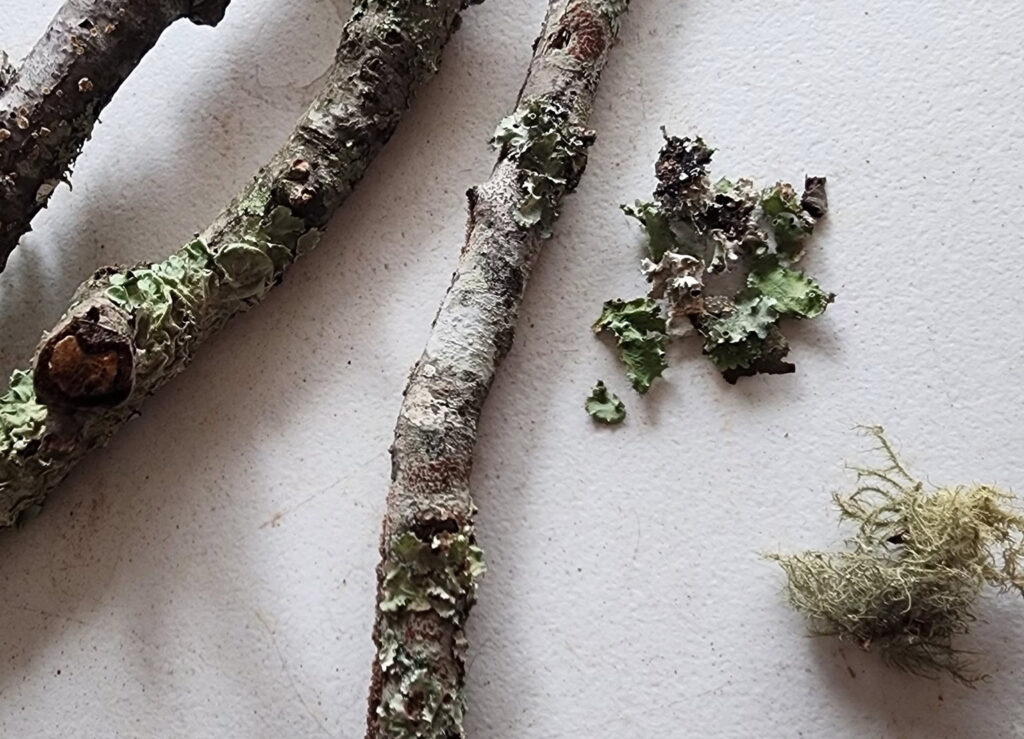
Important note: lichen is very slow to grow and reproduce. Excessive harvest of lichen can destroy populations for many years. Best practice is to harvest from surfaces that are already headed for decomposition or destruction, such as firewood or downed limbs.
Testing Lichen for Dye Potential
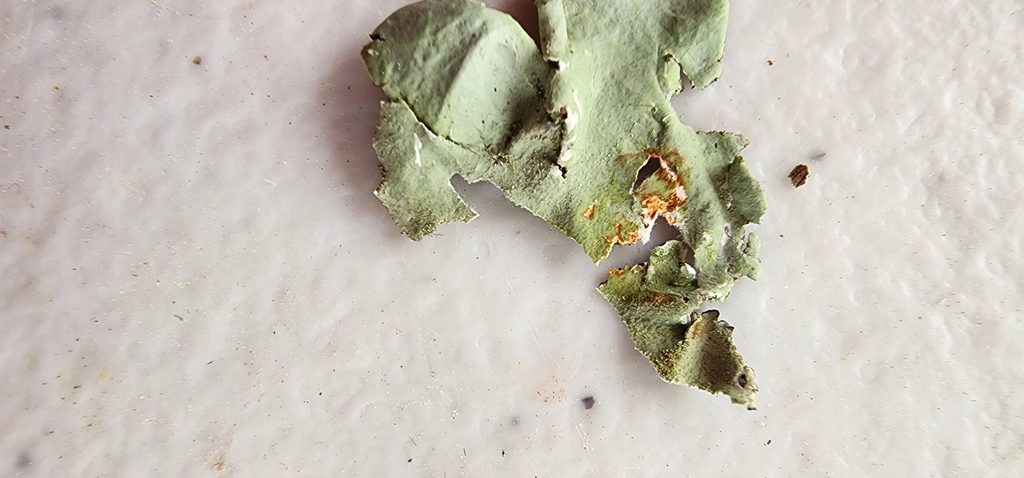
Dye compounds in lichen will typically react visibly when exposed to caustic substances. To test, scratch or scrape the surface of a small piece of lichen. Apply a drop of bleach to the surface and watch for any change of color. The color created by exposure to bleach is not always indicative of the color dye that can be extracted from the lichen.
Methods of Dyeing with Lichen
Some dye compounds in lichen can be released by boiling. Others require extraction in ammonia. Orchil can only be extracted with the ammonia method.
Resources
- Elisa Calà, Marcello Benzi, Fabio Gosetti, Andrea Zanin, Monica Gulmini, Ambra Idone, Ilaria Serafini, Alessandro Ciccola, Roberta Curini, Isabella Whitworth, Maurizio Aceto, Towards the identification of the lichen species in historical orchil dyes by HPLC-MS/MS, Microchemical Journal, Volume 150, 2019, 104140, ISSN 0026-265X, https://doi.org/10.1016/j.microc.2019.104140.
- Kok, A. (1966) ‘A Short History of the Orchil Dyes’, The Lichenologist, 3(2), pp. 248–272. doi:10.1017/S002428296600029X.
- I. Vanden Berghe, Margarita Gleba, Ulla Mannering, Towards the identification of dyestuffs in Early Iron Age Scandinavian peat bog textiles, Journal of Archaeological Science, Volume 36, Issue 9, 2009, Pages 1910-1921, ISSN 0305-4403, https://doi.org/10.1016/j.jas.2009.04.019.
- Ina Vanden Berghe, Ulla Mannering, Charlotte Rimstad, “New dye analyses of Danish Viking Age textiles from Bjerringhøj , Hvilehøj, and Hedeby”, Journal of Archaeological Science: Reports, Volume 49, 2023.